Fallout-Inspired Power Armor Cosplay Ideas to Start Now
Convention season is already buzzing with Fallout-inspired builds. Whether you came in through the games or the Amazon TV series, 2026 is a strong year to plan a wasteland power-armor kit if you want it finished before the next wave of cons. There's never been a better time to plan your build, and if you want to actually finish before the season drops, you need to start now.
This guide covers the best Fallout-inspired power armor variants to tackle this year, some outstanding non-power-armor options that still command serious floor presence, and a practical path forward for getting your build done right.
Why Cosplayers Should Start Building Now
What We Know About Season 3 So Far
The Amazon TV series put these silhouettes in front of a much wider audience. Fans who never picked up a controller are showing up at cons looking for wasteland kits, Vault Dweller looks, and power armor they can actually wear.
What that means for cosplayers is enormous. Convention floors in 2026 are going to be packed with Vault Dwellers, raiders, and Ghoul cosplayers riding the Season 2 wave. The builders who stand out (the ones who get photographed hundreds of times and end up on every convention recap post) will be the ones who started months earlier and built something extraordinary.
Power armor is the defining visual of that Fallout-inspired look. It's the shot from every trailer, every thumbnail, every poster. If you want to make a statement, a well-executed power armor build does it instantly.
Why the Best Convention Cosplays Start Months Early
There's a rhythm to convention cosplay that experienced builders know well: the people who throw builds together in the final two weeks before a con are the ones who show up with unpainted edges, ill-fitting straps, and pieces that fall off mid-parade. The people who win (who get stopped constantly, who land the shots that go viral) started four, five, sometimes six months out.
Power armor builds, especially, reward patience. You're working with large structural pieces, complex paint and weathering stages, and a wearability challenge that requires multiple fit tests and adjustments. Rushing that process is how you end up miserable on the con floor.
If you want to be the T-51B at Dragon Con or Gen Con this year, April is not early; it's right on time. Check out our 90-day build timeline guide for a week-by-week breakdown of how to pace your build from first cut to convention day.
The 5 Best Power Armor Variants to Cosplay
T-51B Power Armor
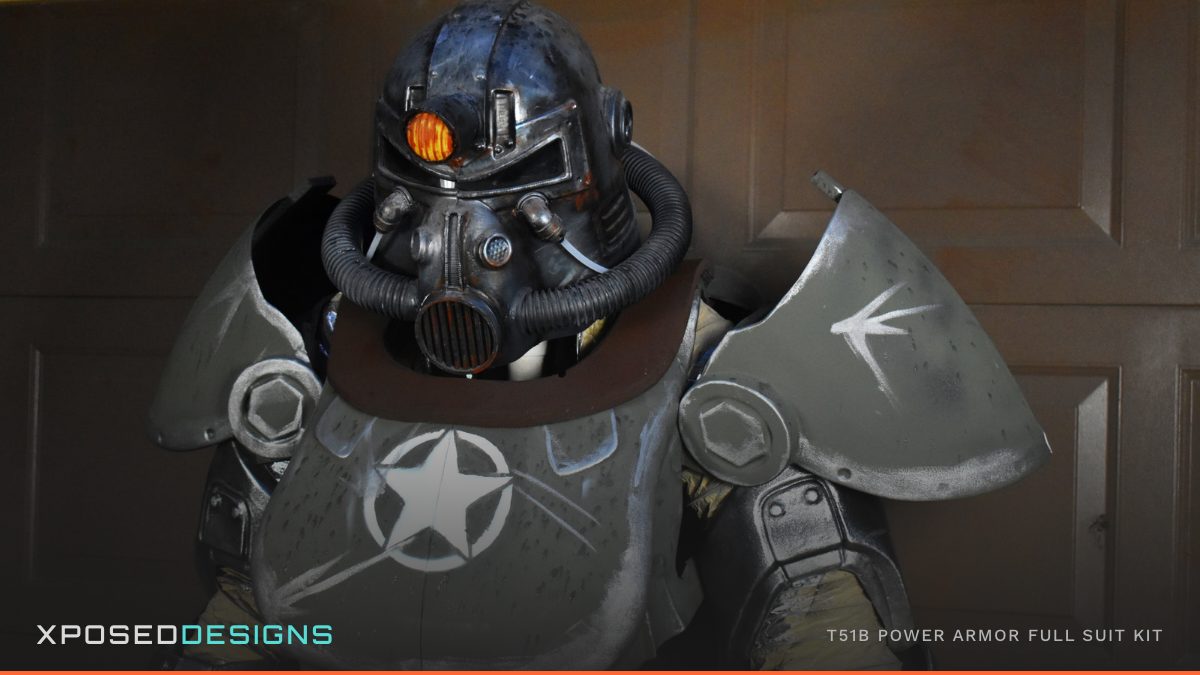
The T-51B is the iconic silhouette most people picture when they hear "power armor." It's the suit on the box art, the one that launched a thousand renders, and it has deep roots going back to the original 1997 game. The rounded, retro-futuristic design has a timeless quality that reads instantly to anyone even passingly familiar with the franchise, making it enormously effective on a convention floor.
For cosplayers, the T-51B is also one of the most rewarding builds because the smooth curved forms work beautifully in rigid materials. The large sweeping pauldrons, the domed chest, the barrel-like torso: these shapes are born for thermoformed ABS plastic, where you can get that clean, factory-line look that EVA foam struggles to replicate. A weathered T-51B in worn blue-and-yellow paint is going to stop traffic.
XposedDesigns' T-51B inspired Power Armor Full Suit Kit is the fastest path to a kit build with those shapes already formed. The kit includes pre-formed ABS pieces for the full suit, letting you skip the hardest part of the build (getting the shapes right) and focus your energy on assembly, fit, and finish.
T-45 Power Armor
The T-45 is the workhorse suit in that lineup: clunky, utilitarian, clearly a product of wartime necessity rather than polish. That rough, cobbled-together aesthetic actually makes it a fascinating build challenge. You want asymmetry. You want visible weld lines and patch repairs and heavy weathering. The "flaws" are the point.
From a practical standpoint, the T-45's blockier geometry is genuinely more forgiving for first-time armor builders. The forms are less complex, which means more margin for error. If this is your first power armor build, the T-45 lets you develop your skills while still producing something that looks great.
Visually, the T-45 reads as gritty and lived-in. Expect heavy interest in T-45 inspired cosplay this convention year.
T-60 Power Armor (Brotherhood of Steel)
If you want the Brotherhood of Steel look, the T-60 is your build. It's sleeker than the T-45 but meaner than the T-51B, a suit that projects power and authority. The Brotherhood paint scheme (dark steel with red accent markings) is one of the most visually distinctive looks in the lineup.
T-60 cosplay reads extremely well in group builds, too. A squad of three or four Brotherhood soldiers in matching T-60 is genuinely iconic convention material.
X-01 Advanced Power Armor
The X-01 is for the cosplayer who wants jaws on the floor. This is the sleekest, most "advanced" looking suit in the game (pre-war military hardware at its peak), and its smooth, almost art-deco design language is visually striking in a way that other suits aren't.
Fair warning: the X-01's smooth forms are unforgiving. There's nowhere to hide rough edges or uneven curves. This build rewards experience and patience. But if you've done one or two builds before and you want a showcase piece for 2026, the X-01 is the power armor cosplay equivalent of showing up in a tuxedo.
NCR Salvaged Power Armor
This one is for fans of the NCR look and the cosplayers who want something that reads as distinctly their character rather than a faction uniform. NCR Salvaged Power Armor (the jury-rigged, mismatched kit cobbled together from T-45 and T-51B parts and painted in NCR colors) has a following that's intensely passionate.
It's also a legitimately interesting build project because it invites you to mix references, improvise, and make deliberate design choices. You're essentially building a character rather than recreating a prop.
Non-Power-Armor Looks That Still Turn Heads
Power armor gets the most attention, but the same wasteland lineup is full of outstanding armor designs that are more wearable, more comfortable, and in some cases even more photographed on con floors.
NCR Veteran Ranger
This might be the single most beloved armor design in that lineup. The combination of the long trench coat, the hard-plated chest, vambraces, and that unmistakable gas mask silhouette creates an image that is immediately recognizable to franchise fans and visually arresting even to people who only know the look from the TV series.
The NCR Veteran Ranger Chest Plate + Forearm Kit gives you the hard armor elements in pre-formed ABS, letting you pair them with your own costume base and trench coat for a cohesive, durable build. This armor survives convention wear in a way that foam counterparts simply don't.
Combat Armor
Combat Armor occupies a sweet spot that a lot of cosplayers overlook: it's recognizable, it's modular (you can wear just the chest and skip pieces that aren't working for you), and it's genuinely comfortable to wear for a full convention day compared to a full power armor suit.
XposedDesigns' Combat Armor Full Set kit covers the major pieces (chest, back, pauldrons, arm guards, leg pieces) in durable ABS plastic. It's also a great gateway build for cosplayers who want to work up to a full power armor suit. See our difficulty rankings guide for a full breakdown of where Combat Armor sits relative to other wasteland builds.
Vault Dweller (Budget-Friendly Entry)
If you want a Fallout-inspired look without the commitment of a full armor build, a well-executed Vault Dweller costume is always a crowd-pleaser. A quality Pip-Boy prop, the right jumpsuit fit, some weathering, and solid character photography can produce an outstanding final result. It's also a natural base layer if you plan to eventually add armor pieces over time.
ABS vs. EVA vs. 3D Printed: Which Material for Your Build?
Choosing the right material is probably the most consequential decision you'll make for your build, and the answer isn't the same for every cosplayer or every build. The short version: ABS plastic holds up at conventions in ways that EVA foam and 3D prints often don't, and the clean surfaces you can achieve with thermoformed ABS are uniquely suited to the smooth-form aesthetic of most of these power armor designs.
For a full breakdown of the tradeoffs between all three materials (including cost, skill requirements, durability data, and finish quality) read our ABS vs. EVA vs. 3D Printed Cosplay Armor guide. It covers everything you need to make an informed decision before you commit to a build approach.
How to Start Your Power Armor Build Today
Option 1: DIY Kit (Fastest Path)
A pre-formed kit like the ones XposedDesigns offers is the fastest path from zero to convention-ready. The hardest part of any armor build (getting the shapes right) is already done. The pieces are thermoformed ABS plastic, cut to the correct profile, and ready for you to sand, prime, paint, and assemble.
This is the route for cosplayers who want a great result without spending months on freehand pattern-making and trial builds. You still get the satisfaction of finishing and personalizing the armor yourself; you just skip the geometry problem.
Option 2: Full Build from Scratch
Scratch builds are for cosplayers who want total creative control: the ability to modify proportions, add custom details, or create a build that's uniquely theirs. This path requires more skill, more time, and more iteration. If you're going scratch-build, start by deciding on your material (again, see the ABS vs. EVA guide), studying reference images obsessively, and building test pieces before committing to your final materials.
Scratch builds typically add 4–8 weeks to the timeline versus starting from a kit, depending on your experience level.
Planning Your Timeline
Whatever path you choose, a structured timeline is the difference between a finished build and a panic-assembly the night before the con. See our 90-day cosplay build timeline for a complete week-by-week schedule that takes you from character selection through final fit check, with buffer time built in for the inevitable do-overs.
Where to Buy Cosplay Armor Kits
The cosplay armor market is noisy. You'll find options ranging from cheap overseas foam imports to wildly expensive full commissions. Here's the honest landscape:
Overseas foam kits are cheap but inconsistent. Quality varies enormously between sellers, customer service is often difficult, and the materials frequently don't survive more than one or two conventions. You also run into the foam durability problem: dents, tears, and compression damage after travel.
Custom commissions from experienced armor builders produce spectacular results but come with price tags that reflect weeks of skilled labor. Expect $1,500–$5,000+ for a full power armor commission from a reputable maker. That's the right choice for some cosplayers, but it's not accessible for most.
XposedDesigns is built around the gap between those two options. US-made thermoformed ABS kits (the same material properties as professional-grade cosplay armor) at a price point that makes sense for cosplayers who want to build something they're proud of without spending commission money. The kits ship domestically (no international shipping delays or customs headaches), and a 4.9-star average across hundreds of customer reviews means you're buying from a maker who actually stands behind their products.
Whether you're looking for the T-51B power armor kit, the NCR Veteran Ranger armor pieces, a full Combat Armor set, or just the unassembled DIY kit to customize completely, XposedDesigns has the foundation for a build inspired by post-apocalyptic games like Fallout: unassembled DIY kits you glue, paint, and strap yourself.
Browse XposedDesigns' full armor kit catalog at xposeddesigns.com and lock in your build before convention season hits.
Planning a Dragon Con 2026 build? Read our Dragon Con 2026 Cosplay Planning Guide for everything you need to know about the September timeline and Atlanta-specific prep.